Patent Process in India
Below is the complete step-by-step process for obtaining a patent in India as of 2026.
In India, the patent process is a structured legal journey governed by the Patents Act, 1970 and the Patent Rules, 2003. For a professional in the IP space, navigating this requires a balance of technical drafting and strict adherence to statutory timelines
1. Pre-Filing: The Foundation
Before submitting any paperwork, the invention must meet the “NIU” criteria: Novelty (newness), Inventive Step (non-obviousness), and Utility (industrial applicability).
- Patentability Search: Conducted via the Indian Patent Advanced Search System (InPASS) and global databases to ensure no “prior art” exists.
- Section 3 & 4 Check: Ensuring the invention does not fall under non-patentable categories (e.g., frivolous inventions, mere discoveries of nature, or atomic energy).
2. Drafting and Filing the Application
The application can be filed at one of the four regional Patent Offices (Delhi, Mumbai, Chennai, or Kolkata) based on your jurisdiction.
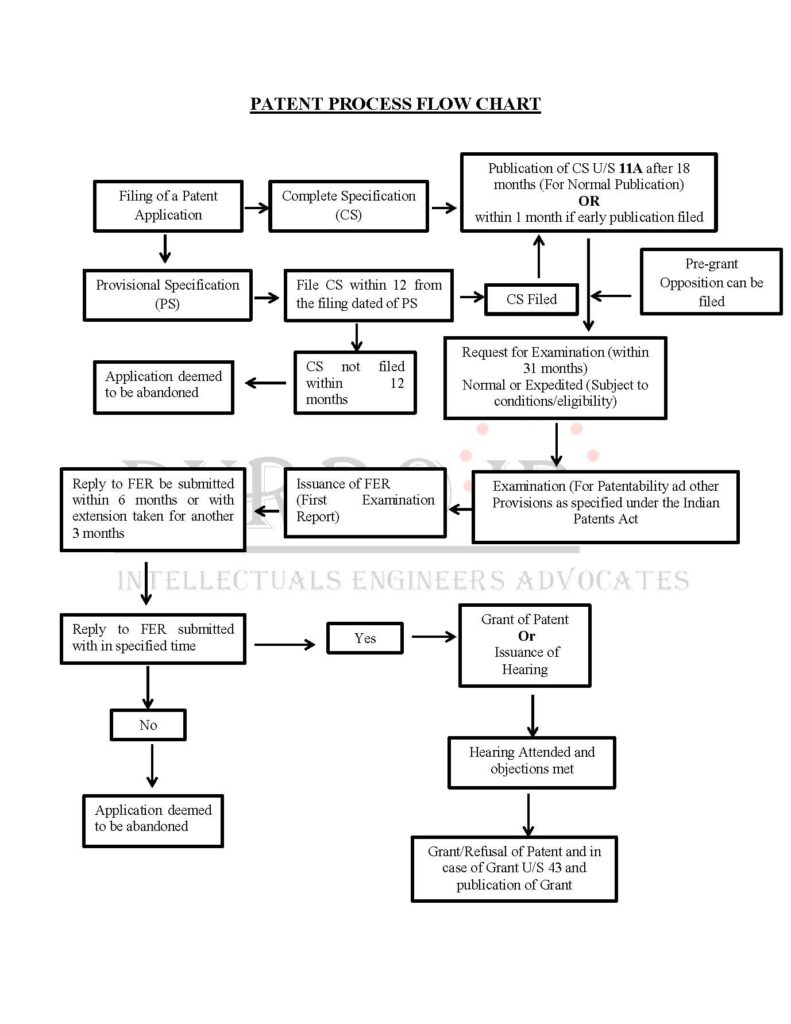
- Provisional Specification (Form 2): Filed if the invention is still in the R&D stage to secure an early Priority Date.
- Complete Specification (Form 2): Must be filed within 12 months of the provisional filing. It includes the abstract, detailed description, and the “claims” which define the legal boundaries of your protection.
- Other Key Forms: Form 1 (Application for Grant), Form 3 (Undertaking for foreign filings), and Form 5 (Declaration of Inventorship).
3. Publication of the Application
Once filed, the application remains confidential for a statutory period.
- Automatic Publication: Occurs 18 months after the filing/priority date.
- Early Publication (Form 9): Can be requested to have the application published within 1 month, which is often done to accelerate the process or to begin claiming provisional rights against infringers.
4. Request for Examination (RFE)
Unlike trademarks, patent examination is not automatic.
- Timeline: A Request for Examination (Form 18) must be filed within 31 months (for applications filed on or after March 15, 2024) or 48 months (for older applications) from the priority date.
- Expedited Examination (Form 18A): Available for Startups, MSMEs, women inventors, and certain other categories to fast-track the grant.
5. Examination and Prosecution
The examiner reviews the application for technical and legal compliance.
- First Examination Report (FER): The examiner issues a report detailing any objections (e.g., lack of novelty or clarity).
- Response to FER: The applicant must respond to all objections within 6 months (extendable by 3 months via Form 4).
- Hearing: If the Controller is not satisfied with the written response, a hearing is scheduled to allow the applicant/agent to argue the case.
6. Grant and Post-Grant
- Grant of Patent: If all objections are cleared, the patent is granted and published in the Patent Journal.
- Term of Protection: Valid for 20 years from the date of filing.
- Renewal & Working: Annual renewal fees must be paid from the 3rd year onwards. Additionally, a Working Statement (Form 27) must be filed every three years to declare the commercial use of the patent in India.
Summary of Government Fees (e-Filing)
| Stage | Individual / Startup / MSME | Large Entity |
| Filing (up to 30 pages/10 claims) | ₹1,600 | ₹8,000 |
| Early Publication (Optional) | ₹2,500 | ₹12,500 |
| Request for Examination (RFE) | ₹4,000 | ₹20,000 |
| Expedited Examination (Optional) | ₹8,000 | ₹60,000 |
PATENT PROCESS FLOW CHART