
Navigating the landscape of Intellectual Property (IP) can be a daunting process, even for the most seasoned innovators. A common pitfall is rushing a project forward without understanding the existing patented domain. Conducting a proper Patent Search isn’t just a legal step; it is a fundamental business strategy that defines risk, validates innovation, and creates competitive advantage.
We at DURRO IP know that a successful patent journey is segmented into clear stages, and the search strategy must evolve with your invention’s development lifecycle. We categorize patent searches into four essential types, each addressing a critical question:
1. The PRIOR ART Search: An Expedition into the Known
This is the logical starting point for any innovator. Before you invest resources in a new idea, you must answer the foundational question: Has this been done before?
A Prior Art Search looks for any evidence that your invention already exists in the public domain. This includes not just issued patents but also published patent applications, scientific literature, technical manuals, and even products already available on the market.
Goal: Exploring the Known.
Key Check: “Is my idea truly unique?”
Why It Matters: This search determines if you are reinventing the wheel. It sets the baseline for what makes your invention novel and prevents the catastrophic loss of investment in developing an idea that cannot be patented.
2. The PATENTABILITY Search: Validating Novelty and Technical Merit
Once you are confident that your core idea isn’t common knowledge, it’s time to technical. The Patentability Search is an advanced investigation designed specifically to determine if your invention meets the strict legal criteria of the Indian Patent Act.
It specifically examines the differences between your invention and the closest “Prior Art” found in the initial step. We evaluate those differences against two key metrics:
- Novelty: Does your final product contain elements that have never been disclosed?
- Inventive Step (Non-Obviousness): Are those differences non-obvious to a skilled professional in that specific technical field?
Goal: Checking for Novelty and Non-Obviousness.
Key Check: “Does my invention meet the rigorous patent criteria?”
Why It Matters: This search tells you if you can file. A strong Patentability Search and analysis directly informs how your patent application will be drafted, optimizing the patent’s scope while minimizing legal risks and future rejections from examiners.
3. The FREEDOM TO OPERATE (FTO) Search: Clearing your Path to Market
A common and dangerous misconception is that having a patent gives you the right to sell your product. This is false. Having a patent only gives you the right to prevent others from making your patented invention. It does not mean your product is free from infringing someone else’s earlier, valid patent.
The FTO Search (also called a “Clearance Search”) is a comprehensive risk-mitigation tool. It focuses heavily on active, enforceable patents that could be infringed by your specific product design or business model when launched. This search typically focuses on the specific geographical markets where you intend to manufacture or sell.
Goal: Clearing Your Path to Market.
Key Check: “Can I sell my invention safely without being sued?”
Why It Matters: FTO is about business continuity. This search ensures you avoid a costly patent infringement lawsuit, which can lead to court injunctions stopping production and crippling damages. FTO validation signals to investors and partners that your commercial roadmap is legally clear.
4. The INVALIDITY Search: Defending your Territory
Innovation is often a defensive game. An Invalidity Search is a powerful strategic asset used when you are facing competition. Unlike the other searches which validate your patent, an Invalidity Search is a targeted investigation aimed at someone else’s existing patent to prove that it should never have been granted in the first place.
This is typically used in two scenarios:
- Challenging Competitors: You find a competitor’s patent blocking your commercial path, and you need to find previous disclosures (Prior Art) they missed that invalidate their claims.
- Defending a Claim: You have been accused of infringement and need to find evidence that the patent you are allegedly infringing was invalid when granted.
Goal: Defending your Invention.
Key Check: “Can I challenge a competitor’s strategic blockage or defend my business?”
Why It Matters: Invalidating a key patent held by a competitor can open an entire market segment, providing significant commercial opportunity and leverage. It is the ultimate tool for navigating intellectual property gridlock.
Choose Your Route Wisely
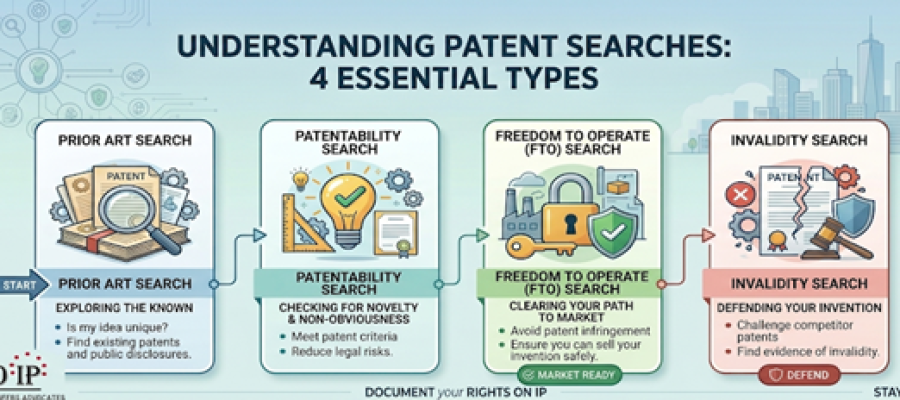
The accompanying infographic provides a clear roadmap of these four essential searches. The patent process is sequential, and skipping steps can lead to severe legal and financial consequences.
A strategic partner like DURRO IP—a firm where Intellectuals, Engineers, and Advocates work in unison—can guide you through this process. Contact us to design a search strategy that protects your innovation and guarantees your commercial success.
🔍 The 4 Essential Patent Searches: A Guide to Reducing Risk and Driving Commercial Success
A great idea is only as valuable as its legal security.
In the complex landscape of Intellectual Property (IP), rushing a commercial launch without a solid patent strategy is the fastest route to high-cost legal gridlock. At DURRO IP, we believe innovation requires legal validation.
The below visual guide simplifies the patent lifecycle, distinguishing between four critical, sequential searches that every innovator, startup, and corporation must consider:
- Prior Art Search: The initial expedition to see if your core idea reinventing the wheel.
- Patentability Search: A targeted analysis ensuring your invention has technical merit (Novelty & Non-Obviousness).
- Freedom to Operate (FTO) Search: The critical step confirming you can commercially launch without infringing existing patents.
- Invalidity Search: A strategic defensive asset used to challenge a competitor’s patent claims.
Don’t let your next major invention stall. Review our infographic to understand the steps.